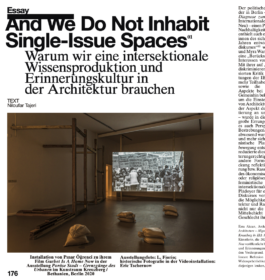
And We Do Not Inhabit Single-Issue Spaces
Why We Need Intersectional Knowledge Production and a Culture of Memory in Architecture
2023
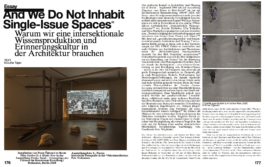
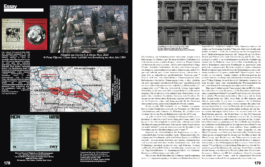
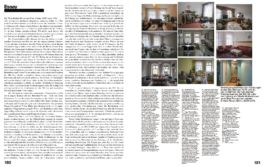
Arch+ Ausgabe 246: Zeitgenössische feministische Raumpraxis, 2022.
Arch+ Ausgabe 246: Zeitgenössische feministische Raumpraxis, 2022.
Arch+ Ausgabe 246: Zeitgenössische feministische Raumpraxis, 2022.
In my first text on intersectionality and spatial practice, I engaged with architectural historians and artists who applied an intersectional perspective to the history of IBA Alt/Neu. This marked the beginning of my exploration of intersectionality and space, which I have continued to deepen ever since.
And this is how the text begins:
"The political struggle over architecture and planning in Berlin, which lasted from the 1968 exhibition 'Diagnose zum Bauen in West-Berlin' (Diagnosis for Construction in West Berlin) to the International Building Exhibition Berlin 1984/87 (IBA Alt/Neu), brought about a paradigm shift within the city and presented demands for greater (social) sustainability and spatial justice. However, the movement also contained an internal struggle. Important figures within 'feminist planning discourse' in West Germany in the late 1970s organized to demand that 'women’s living conditions and women’s interests be taken into account in planning and building.' These women included Kerstin Dörhöfer, Ulla Terlinden, and Myra Warhaftig. Their criticism focused on architecture and planning, which was 'gender unjust‘ (geschlechterungerecht), in other words, which discriminated against women. In doing so, they succeeded in making their demands heard during preparations for the IBA 1984/87, calling for greater participation by female architects and planners, and for 'IBA projects to more strongly consider programmatic aspects of gender sensitive planning.' It is well known that this pressure resulted in the IBA seeking to recruit more women in architecture and planning positions. Moreover, there was an initial achievement: the IBA Alt (Alt = old, for existing buildings) incorporated the needs of participation, in other words, greater participation of socially diverse residents. Nonetheless, many other perspectives, problems, aspirations, and hopes were entirely absent from discourse at that time and have only been made visible in recent years. This was because the feminist planning discourse had emerged from the critique of power articulated by the second women’s movement but reduced this critique to the single aspect of gender injustice. Recent feminist works with an intersectional approach have made clear that the critique of power must reflect other forms of social oppression, including racism and racialization, as well as discrimination based on economic status, sexual orientation, religious affiliation, etc. These more recent analyses can be understood as an appeal to add much-needed complexity to critical discourse. At the same time, they offer a chance to understand justice in architecture and spatial planning as involving more than the needs of white, educated middle-class people, regardless of their gender."
By the Book here– the publication is full of wonderful texts that engage with feminism, intersectionality, space and architecture!
Editorial team of ARCH+: Nora Dünser, Mirko Gatti, Max Kaldenhoff, Anh-Linh Ngo, Melissa Makele; guest editors: Torsten Lange, Charlotte Malterre-Barthes, Daniela Ortiz dos Santos, Gabriele Schaad.
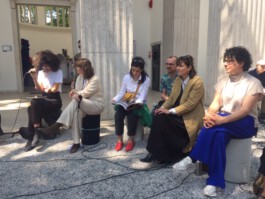
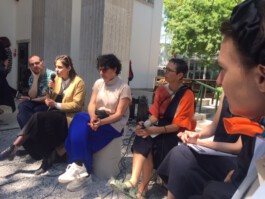
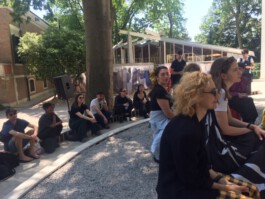
Book discussion in front of the German Pavilion at the Venice Architecture Biennale, 2023. With Elli Mosayebi, Hélène Frichot, Mona Mahall & Aslı Serbest, Melissa Makele, Franziska Gödicke, Torsten Lange, Gabriele Schaad, Charlotte Maltherre-Barthes, summacumfemmer, Juliane Greb, and many others…
Book discussion in front of the German Pavilion at the Venice Architecture Biennale, 2023. With Elli Mosayebi, Hélène Frichot, Mona Mahall & Aslı Serbest, Melissa Makele, Franziska Gödicke, Torsten Lange, Gabriele Schaad, Charlotte Maltherre-Barthes, summacumfemmer, Juliane Greb, and many others…
Book discussion in front of the German Pavilion at the Venice Architecture Biennale, 2023. With Elli Mosayebi, Hélène Frichot, Mona Mahall & Aslı Serbest, Melissa Makele, Franziska Gödicke, Torsten Lange, Gabriele Schaad, Charlotte Maltherre-Barthes, summacumfemmer, Juliane Greb, and many others…
Related Projects